


Lofoten: Ancient Rock, Seasonal Lives

A voyage among friends through a landscape shaped by ice, cod, and the work of fishing families.
By John J. King II
A journey two years in the making
In our photographs from Reine, the houses occupy a narrow margin between the water and the mountain walls. Red and white buildings give the rock its scale, but they also draw my attention away from the summits, toward the places where people have made a life. We had come to Lofoten for the landscape. The company we brought with us made it difficult to see only scenery.

The trip had been two years in the making, set in motion by our daughter Mia's participation in Alt for Norge and the Norwegian family connections that followed. Pam and I began gathering friends we had made along the way in our own lives. Several had strong ties to Alaska's fishing industry and Norwegian family histories of their own. What might otherwise have been a photographic journey began to take the shape of a gathering.
There was already a vessel, and a guide, in our shared experience. Many of us had traveled together aboard Polaris in Svalbard, with Cheesemans' Ecology Safaris and expedition leader and naturalist Scott Davis. When Scott designed a Lofoten itinerary and published an early version, I contacted him immediately about making it a private charter.
With Mia's help, Pam and I also reached out to her newly found Norwegian relatives. We hoped to put the two parts of the journey together: time with family around Bergen, followed by nine days among the islands with friends. The wheels were in motion.

Familiar company, another coast
Polaris was a Scottish-built vessel converted for expedition travel, comfortable accommodation for twelve passengers rather than a large cruise ship. Her ownership and crew were French; on our voyage the ship's crew numbered six, including a brilliant French chef. Cheesemans had chartered the vessel for both our Svalbard journey and this one, with Scott again providing the capable leadership that had helped make the earlier trip worth repeating.
For Pam and me, the fishing connections were more than ancestral. My own years in Alaska fishing and ship operations belonged to the life from which some of these friendships had grown. Pam had worked as a cook and deckhand on Alaska crab boats in the 1970s, beginning as a greenhorn cook on the Marten out of Kodiak; aboard Cascade, she learned to take watches and maneuver the vessel. These were practical responsibilities, acquired through work.
Her Norwegian family history contained maritime lives as well. Jonny Askeland, whom we had just met around Bergen, had gone to sea as a young man, and his family research placed seamanship alongside farming in the story of earlier generations. I would not turn those connections into an inherited aptitude, or claim that they traced a direct line to the Lofoten cod boats. They did give us a way of approaching the coast that went beyond admiration.
We were traveling for pleasure, with a French chef and someone else responsible for the ship. That distinction mattered when we stepped into the rooms arranged to show how seasonal fishermen had lived.

We arrived in Svolvær a day before embarking on Polaris. With that day free, we chartered a high-speed inflatable touring boat to see white-tailed eagles fishing. I am pretty sure I have never gone that fast in any kind of a motorized craft. The village was still full of visitors mostly on vacation from parts of Europe, especially France. Tourism is a major source of income for the region and a highway ties together most of the bigger islands along with the country's Ferry system.


Polaris was a Scottish-built vessel converted for expedition travel, comfortable accommodation for twelve passengers rather than a large cruise ship. Her ownership and crew were French; on our voyage the ship's crew numbered six, including a brilliant French chef. Cheesemans had chartered the vessel for both our Svalbard journey and this one, with Scott again providing the capable leadership that had helped make the earlier trip worth repeating.
For Pam and me, the fishing connections were more than ancestral. My own years in Alaska fishing and ship operations belonged to the life from which some of these friendships had grown. Pam had worked as a cook and deckhand on Alaska crab boats in the 1970s, beginning as a greenhorn cook on the Marten out of Kodiak; aboard Cascade, she learned to take watches and maneuver the vessel. These were practical responsibilities, acquired through work.
Her Norwegian family history contained maritime lives as well. Jonny Askeland, whom we had just met around Bergen, had gone to sea as a young man, and his family research placed seamanship alongside farming in the story of earlier generations. I would not turn those connections into an inherited aptitude, or claim that they traced a direct line to the Lofoten cod boats. They did give us a way of approaching the coast that went beyond admiration.
We were traveling for pleasure, with a French chef and someone else responsible for the ship. That distinction mattered when we stepped into the rooms arranged to show how seasonal fishermen had lived.

The age of the rock
Before those rooms, before the villages and their harbors, there was the rock. Much of Lofoten's exposed continental basement is Precambrian, including extensive intrusive rocks that crystallized about 1.8 billion years ago; the mountains we see now belong to a much later history of faulting, uplift,

It is a distinction worth holding onto. The age of the material is not the age of the shape.
Repeated glaciations excavated hollows and valleys in that resistant foundation, while fractures helped determine where fjords and sounds developed (Geological Survey of Norway). The region's glacial deposits belong to a radically younger interval, with local deglaciation beginning roughly fifteen thousand years ago (Geological Survey of Norway)
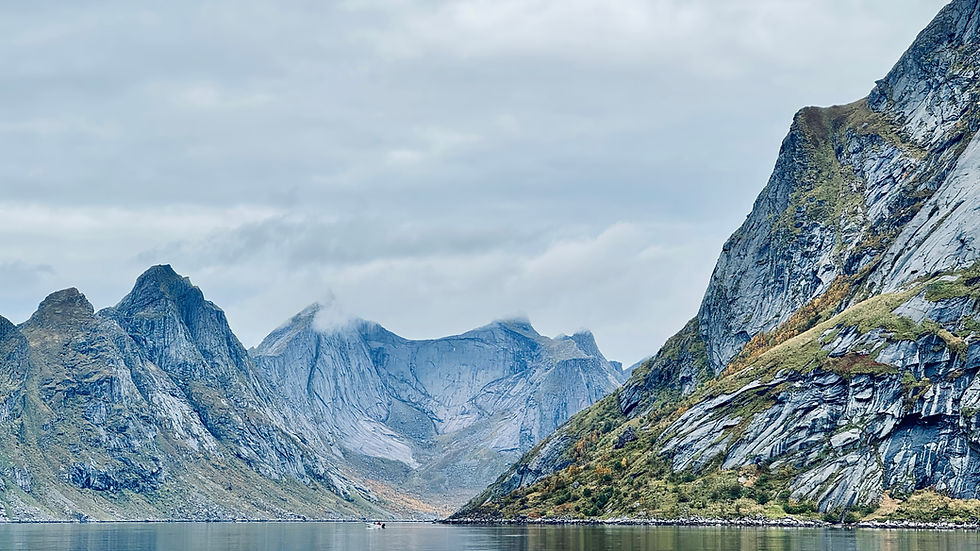
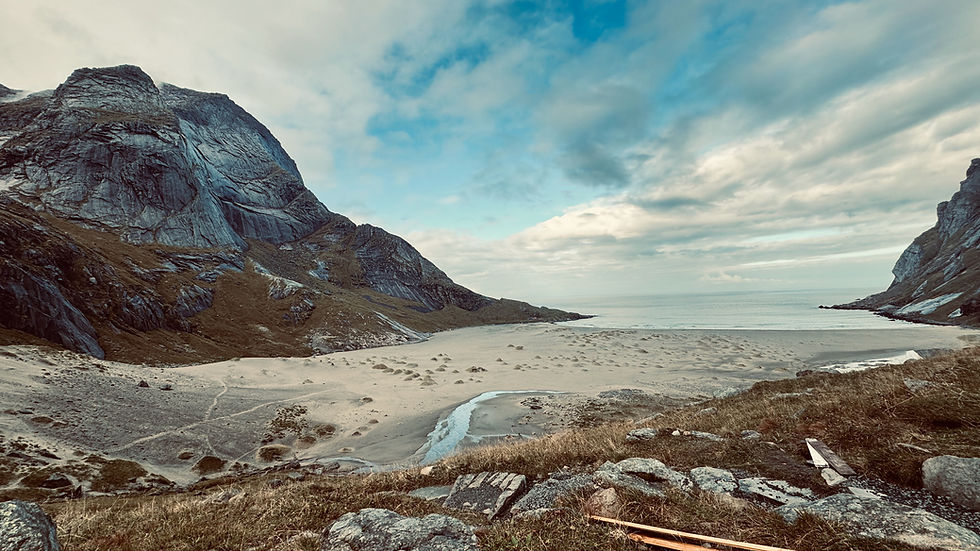
In the photographs, these histories share a single surface. Autumn foliage occupies breaks in exposed rock; a small boat sits beneath enclosing mountain walls; a pale beach makes a brief opening along a dark shore. The light that gives a photograph its particular character lasts only a fraction of the time we were there. Behind it are processes whose duration is difficult to keep in mind even while looking directly at their results.


The season we did not see
We visited in September. The great seasonal gathering that shaped these villages belonged to winter and early spring, when Northeast Arctic cod, the migratory skrei, came south to spawn in the waters around Lofoten (Museum Nord). Our autumn photographs therefore show the setting of that fishery, not its busiest season.
For generations, visiting fishermen came from far along the northern coast, sailing and rowing considerable distances in open boats, often the traditional Nordland boats (Museum Nord). They rented cabins known as rorbuer, finding temporary quarters near the fishing grounds and the buyers for their catch (Museum Nord).

The old photographs gathered the fleet into a crowded field of boats. The museum interiors brought the account down to a room: a tabletop, glass floats, nets and lines against timber walls. Here was a scale I could begin to understand, not the fishery as an export industry, but the limited space available to people trying to make a season pay.
The cabins were places to cook and sleep, dry clothes, bait long-lines, and repair nets (Flakstad and Moskenes local history). They were not retreats from the working day so much as another part of it.


A household behind each boat
The fisherman in the open boat is the most visible figure in this history. Museum Nord's account of the lofotkista, the chest packed for the season, points toward the work behind his departure: food, clothing, and bedding prepared on the home farm, much of it through women's labor (Museum Nord, the Lofoten chest).
Agriculture, livestock, and the making of woolen and other garments helped supply the season at sea; fishing was part of a household economy that often included a small farm, not an occupation detached from the work ashore (Museum Nord, the Lofoten chest; Museum Nord, history of Lofoten). To look only at the boats is to leave much of that preparation outside the frame.
The catch was not the only uncertainty. In the nineteenth-century fishing villages, a landowner-merchant might provide the cabin, sell supplies, and buy the fish; fishermen renting his accommodation were commonly obliged to deliver their catch to him at his price (Flakstad and Moskenes local history). Shelter and access to a market could be parts of the same unequal bargain.


That history changes the meaning of a picturesque cabin. The red walls remain beautiful, but the building also belongs to an account of labor, dependence, and the effort to carry something home. Looking at our photographs of the furnished rooms, I want to leave room for the family beyond the fisherman, and for the work that made his departure possible.

Pam's own experience offers a useful caution against making the division too simple. Her Alaska work was aboard the vessel, in the galley and on deck, and eventually included standing watches. A fishing family's life cannot be represented by one figure at sea and an anonymous household somewhere behind him.


Bergen, and the coast still at work
Our journey had connected Bergen and Lofoten for personal reasons, but dried cod had joined them long before us. Stockfish from the islands traveled through Bergen's merchants to European markets, drawing the fishing villages into a much wider commercial world (Museum Nord). That is a connection between places, not evidence that Pam's relatives took part in the trade.
Nor does the museum contain the whole life of the contemporary coast. Cod and stockfish remain important in Lofoten, while tourism has developed partly through the reuse of fishermen's cabins and the appeal of an active fishing culture (Museum Nord; Nordic Council of Ministers).

We were part of that visitor economy. We had chartered a vessel, come ashore with cameras, and carried away images of places where other people continued to live and work. The least I can ask of the photographs is that they do not make the working coast disappear beneath its beauty.

The people in the last photograph
There is a temptation to end with the largest view: the mountain reflected in still water, or the full rainbow reaching across a ridge. I would rather finish with the people who shared the journey. The mountains account for why we wanted to come; our companions help explain why this became our particular trip.


Mia's experience had opened a way toward family in Norway. Scott's itinerary gave us a reason to bring friends together aboard a vessel many already knew, and Pam and I had the pleasure of seeing those possibilities become an actual journey. Among the photographs of ancient rock and seasonal quarters, there should be room for that smaller history too: friends made over a lifetime, gathered for nine days on the water.


Comments