


Report from the Pacific: The Long Way North (Part I)

Updated: May 7
This first report from the Pacific Flyway begins as a kind of reorientation—away from the familiar rhythms of Cape Cod, where we have mainly observed shorebirds when they gather in their southbound passage, and toward a coastline where spring reveals the other half of the story. Here, movement is north, the urgency less theatrical but no less absolute, and the birds arrive not as a culmination, but as a prelude.


The tents go up again, as they do every year, with a kind of practiced optimism that might seem excessive if you didn’t understand what was at stake.
A coastal community—never quite as orderly or as consequential as it hopes to be—commits itself to welcoming birds that neither know nor care that they are being welcomed. There are maps, volunteers, children drifting between attention and distraction. And yet beneath the modest choreography of a shorebird festival is something more deliberate: an attempt to make visible a system that only works if enough people choose, repeatedly, to notice it.
Because what becomes apparent, standing along these estuaries, is how much of migration depends on what holds.


A whimbrel does not “visit.” It arrives having committed to a route that begins along the coasts of South America and extends, in stages both known and uncertain, to breeding grounds in western Alaska. A red knot follows its own austere logic, moving from the southern hemisphere to the high Arctic, its body transformed into a temporary engine for distance, dependent on a precise sequence of functioning habitats. Neither bird knows, on departure, whether those places will remain intact.
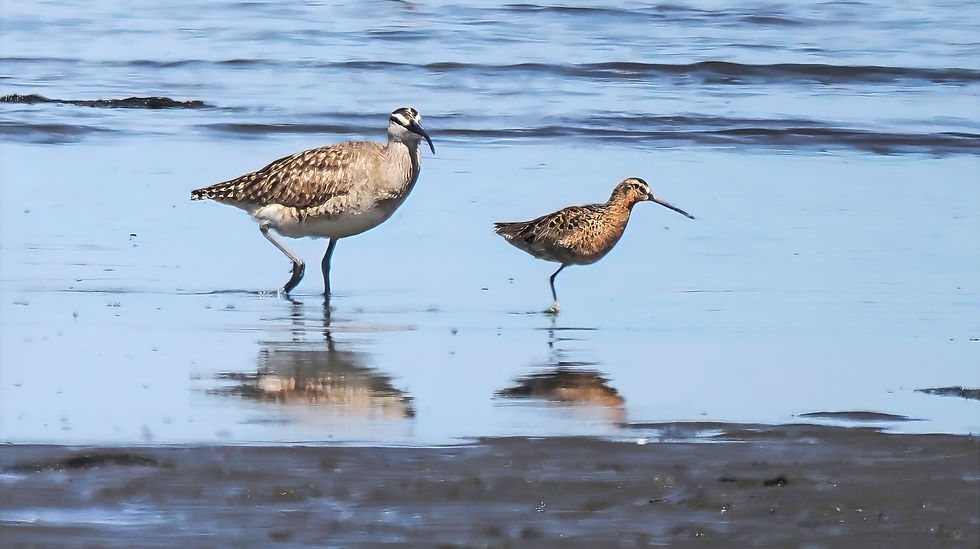
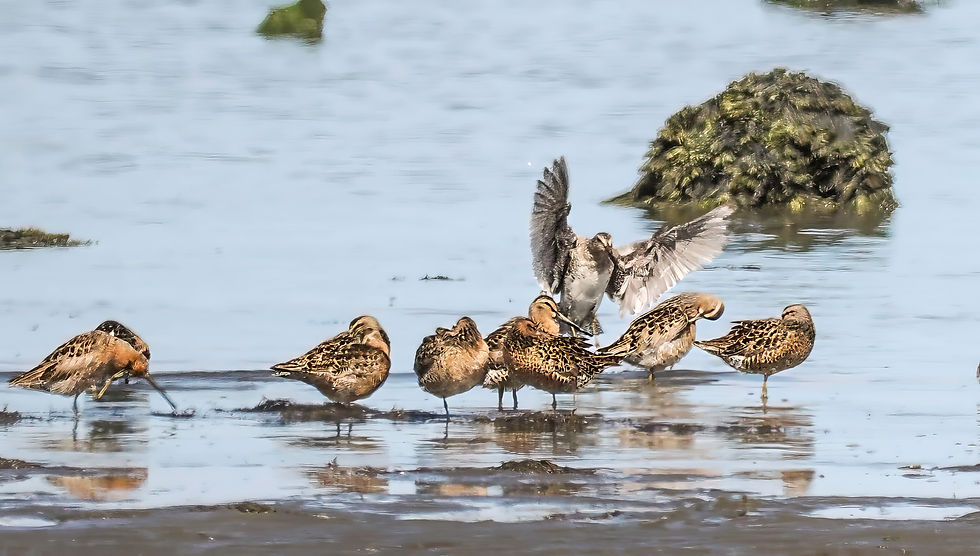


And then there are the western sandpipers, whose abundance almost disguises the precarity beneath it. They move north in immense, coordinated flocks, gathering along estuaries in numbers that seem to convert landscape into motion. Along the way, places like Kachemak Bay on the Kenai Peninsula become briefly indispensable—dense feeding grounds where the birds refuel before continuing to Alaska’s North Slope to breed. Their numbers suggest resilience; in fact, they reflect concentration. So much depends on so few places continuing to work.
This is the quiet argument embedded in the festival.


Pacific Flyway: Red Knot (Calidris canutus roselaari)
Biologists estimate that one third of the C.c. roselaari population spends the non-breeding season on the Pacific coast of Baja California, in bays protected from further development by the presence of industrial salt mines. Some juvenile birds remain in coastal estuaries of the northern Sea of Cortez for their first year, as they await breeding maturity at two years old.
Little is known about the migration sites of a relatively small population that travels along the Pacific coast of the Americas. Willapa Bay and Grays Harbor on the Washington Coast is the major stopover on the northern migration to the Alaskan coast and Wrangell Island. Flocks migrate southward from Eastern Asia and Alaska along the Pacific Coast to winter in Baja California and the Caribbean.


Children watch black turnstones flipping stones with mechanical focus. They learn that black oystercatchers and surfbirds exist only along this narrow Pacific edge, their lives bounded by wave and rock. They begin to understand that some species remain—snowy plovers, Wilson’s plovers—while others move in shorter arcs, and still others, like whimbrels and surfbirds, traverse the full length of the Americas. And then the story becomes more complicated: Hudsonian godwits crossing flyways entirely, marbled godwits traversing a continent, migration as something less linear than contingent.
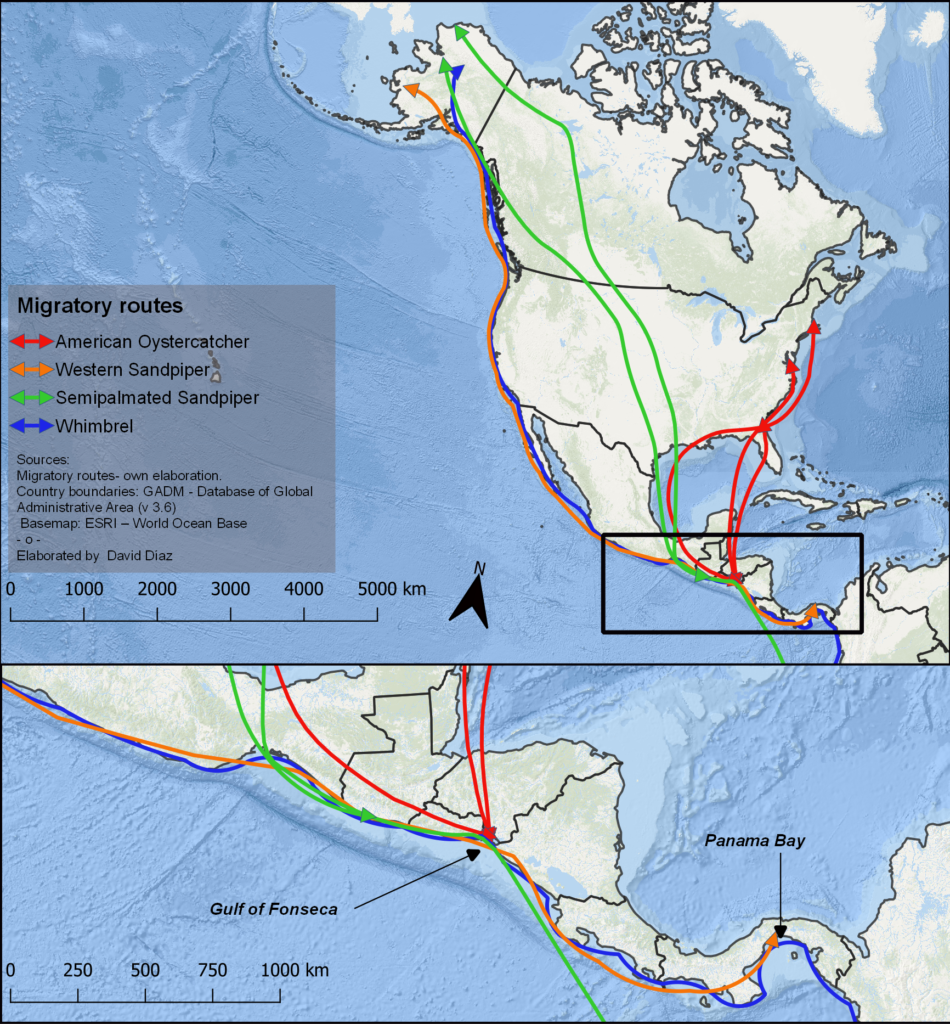
The map refuses simplicity. It stretches, overlaps, and contradicts itself—a network that functions only if its many parts, across countries and coastlines, continue to align.
Which is precisely the problem.
Because while the birds operate within this dispersed and ancient system, the pressures on it are local, incremental, and often invisible until the moment of failure. A wetland filled. A shoreline disturbed. A decision made without recognition of what depends on it. The chain does not break all at once; it erodes.
The festival, for all its modesty, is an effort to counter that erosion—not by scale, but by repetition. Year after year, the community steps forward to hold its portion of the flyway in place. What it produces, over time, is not just awareness but continuity: a transfer of attention from one generation to the next, until stewardship begins to feel less like obligation and more like inheritance.


In the weeks ahead, the journey extends north to Alaska, where the logic of migration resolves briefly into purpose. There, in the compressed abundance of the Arctic summer, breeding unfolds quickly, almost urgently, and the young of the year enter a world that offers little instruction beyond immediacy. What they learn, they learn fast, or not at all.
Later still will come the turn, when the first southbound migrants begin to reappear along the coast, carrying with them the outcomes of that brief northern season.
Between departure and return lies the same uncertainty that has always defined the journey: a chain of places that either holds or doesn’t.
Here, at least, people have decided that it will.
A few bonus birds we spotted on our travels on the coast.


Stay tuned for further reports as we will visit Alaska in late June. Heading to Nome, Utqiagvik and Prince William Sound, the heart of nesting grounds for some species..


Comments